For a research group
A group’s design work runs on somebody’s laptop, in an environment nobody else can reproduce. Here it runs in one place, for everybody — with the systems code in the loop and a colleague who has actually read the build.
The loop
A project that carries a PROCESS deck beside its build config shows two halves of one machine: the Model, which is your sliders, and PROCESS, which is the run. Every slider says who owns its number — you send it, the solver iterates it, PROCESS solved it — and turns amber where your value and the run disagree, shown rather than silently reconciled. Type a new value into an input the deck fixes and PROCESS re-solves the plant in a minute or two: the whole machine comes back re-sized, not estimated. Move a parameter across the problem — hand it to the solver, or pin it back.
Read why a run came out the way it did: on a converged run, the limits it sits exactly on; on a failed one, the limits it missed and the bound each wanted, plus where the solver ran out of room against your deck’s own bounds. Compare any two solved points as their difference — yesterday’s run, or EU-DEMO. Scan three to nine points on one axis, or a plane on two, each point a whole solve, with the feasibility boundary drawn where it flips: not it works but it works up to here. Then adopt the solved point into the sliders and rebuild. Nothing ever rewrites your IN.DAT — the deck is a document you authored.
The agent argues
On the research path — BlueAgent SCI — Hartmut is the persona. He assumes you know the physics, pushes parameters to their limits and argues the trade-offs with numbers. He reads the actual build, the code rather than a summary of it, and the actual run — a figure from your PROCESS study is quoted as a systems-code result and says so. He answers like a colleague:
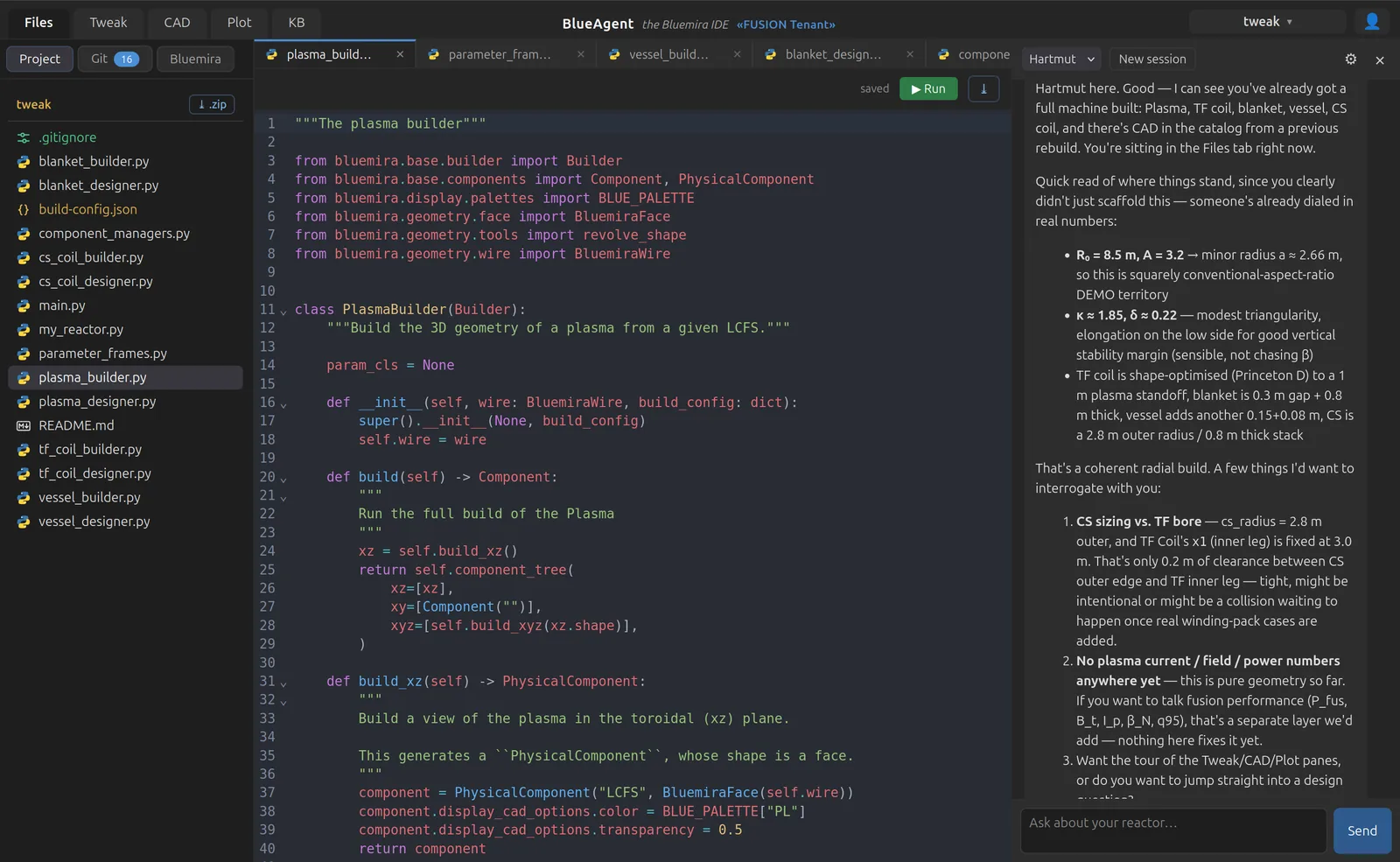
R₀ = 8.5 m at A = 3.2 gives a ≈ 2.66 m — squarely conventional-aspect-ratio DEMO territory. κ ≈ 1.85, δ ≈ 0.22: elongation on the low side for vertical-stability margin. Sensible, not chasing β.
What I would interrogate:
cs_radiusis 2.8 m outer and the TF inner leg is fixed at 3.0 m — that is 0.2 m of clearance. Tight. Intentional, or a collision waiting to happen once real winding-pack cases are added?
Sabine is the other half of that: an adversarial reviewer who critiques and never builds. /sabine in the chat, or the peer-review button under the sliders, runs the current configuration past her once — worst problems first — and a design is unconvincing until it survives her.
What neither document says
Your configuration holds the coil; the run holds the machine. Neither holds the ripple that coil actually produces at the plasma edge, because it is not a shared name — it is a consequence, and the only way to have one is to compute it. So BlueAgent computes it, with Bluemira’s own Biot-Savart solver, from both halves; reports every input and the document it came from; and where the design misses PROCESS’s limit, says what would meet it. The inboard build gets the same treatment: solenoid, coil, vessel and blanket stacked at the midplane, every gap named, and a verdict on whether it closes.
One installation
Every group knows the setup that runs on one machine and nowhere else: it took a week to get right, nobody dares update it, and when its owner leaves it leaves with them. Here the group shares one hosted installation — same Bluemira version, same environment, same results for every member, every plot reproducible by whoever reviews it. Whoever joins works on day one, and the new PhD student’s first afternoon is a Full Rebuild, not a conda environment.
Your design stays yours
One tenant per group: files, threads and designs stay inside it, and no other group’s work touches yours. Hosted on our machines in the EU — Germany and France — no CDN, no analytics, nothing loaded from anywhere else. What you send the agent goes to Anthropic in the USA to be answered — on the EU Standard Contractual Clauses, and under their API terms it is not used to train models. That is the only thing that leaves your tenant.
Bring your own Anthropic key and inference is billed to you directly by Anthropic — the seat price is all you pay us. On our key instead, inference draws on prepaid credit with a hard ceiling and every turn on the statement.
PROCESS, per seat
Solving is an add-on beside any plan, per seat rather than per tenant — the one person who runs the system studies can have it without moving the whole group, and a SCI seat has it already. Reading a run is free on every plan. It is the first of a category: the next code docks the same way.
A group tenant is created with the first seats, and seats move between plans when the work moves. See what each plan can do.