For a course
Thirty students, twelve weeks, one tokamak each. The syllabus is the physics. The workbench is where the physics becomes something you can drag — and where a question gets its answer while it is still a question.
What a student does
A project starts on a learning track — Simple-Tokamak for the gentle way in, ITER-Learn, DEMO-Learn or STEP for a machine with a name — and the first thing on every track is the plasma, because a fresh project builds nothing yet. Becky builds it with them. Then Full Rebuild, and the CAD tab fills with a torus they can cut open. From there it is the loop the Tweak tab exists for: drag a slider, watch the cross-section follow, rebuild, look, ask. Hover the major radius and the coil envelope, the blanket wall and the vessel light up amber — that is the dependency graph of a reactor, and nobody had to draw it on a board.
Each track keeps a checklist of milestones against the actual build, and the last milestone is the same on every track: open a finished design beside your own — EU-DEMO, a spherical tokamak, or the one that asks a 7 m machine for 500 MW and has no solution — and read what a systems code decided that the geometry could not.
What the agent does
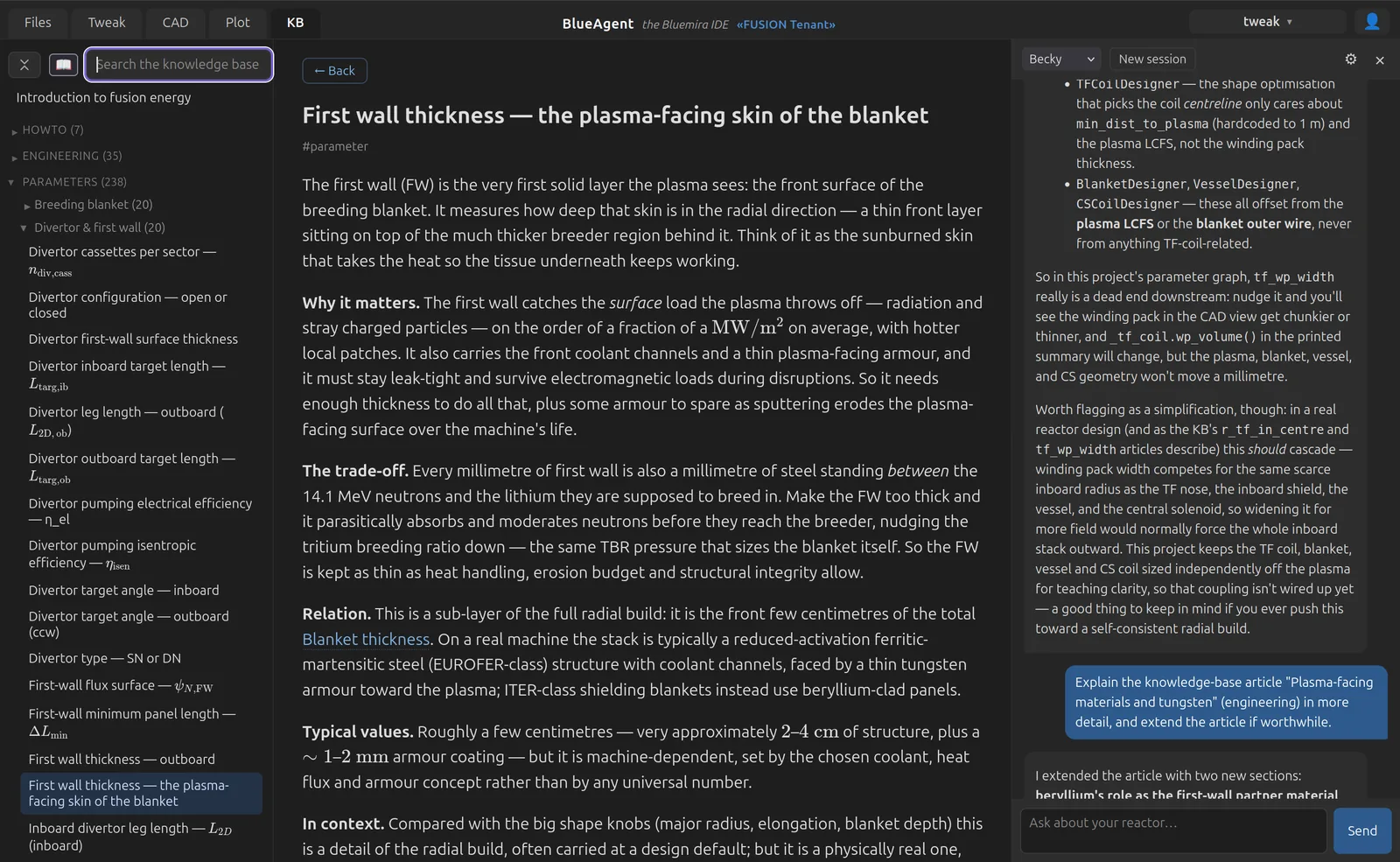
BlueAgent EDU is Becky, the mentor. She explains why the blanket is that thick, what elongation buys and what it costs, at the moment the question occurs, against a knowledge base she cites and extends. She reads what is on the screen, so her directions match it; she writes code and runs it in a sandbox, and shows the diff before anything lands. Every slider has an ask button that hands her that parameter with its value and its consequences — faster than typing the question, and the question arrives exact.
The knowledge base grows with the project: articles on every concept touched, in the context of that student’s reactor, and at the end one printable textbook out of the lot. A course that only needs CAD, plots and the sliders takes Bluemira IDE, the tier without the agent — and without any inference cost at all.
The room
One installation for the whole course, the same Bluemira version for everybody, and everyone signs in from a browser on the laptop they own. That is all there is to say about installation, and it is the last time this page says it. Seats belong to the course, not the person: when somebody drops out, the seat moves on to the next.
A licence shaped like a semester
EDU seats for a course come as a semester: five monthly rates — €95 a seat — for a six-month term that ends by itself. Nothing renews, nothing to cancel, no subscription outliving the course.
Inference runs on prepaid credit with a hard ceiling, so a curious class cannot overrun the course budget. An institute running several courses is its own arrangement — see institutional licences.
A course tenant is created with the first seats. See what each plan can do — or tell us the course and we will size it with you.